Senin, 11 Maret 2013

bugs bunny

Bugs Bunny

From Wikipedia, the free encyclopedia
Jump to: navigation, search
Bugs Bunny
Classic bugsbunny.png
First appearancePorky's Hare Hunt (early version)
April 30, 1938
A Wild Hare (official debut)
July 27, 1940
Created byBen Hardaway, Cal Dalton (prototype)
Tex Avery (official)
Voiced byMel Blanc (1940–1989)
(see below)
Developed byBob Clampett
Friz Freleng
Chuck Jones
Robert McKimson
Information
SpeciesRabbit or hare
(see below)
GenderMale
Significant other(s)Lola Bunny, Honey Bunny
Bugs Bunny is a funny animal cartoon character, best remembered for his starring roles in the Looney Tunes and Merrie Melodies series of theatrical shorts produced by Warner Bros. during the Golden Age of American animation.[1] His popularity during this era led to his becoming a corporate mascot of Warner Bros. Entertainment. Bugs is an anthropomorphic gray hare or rabbit and is famous for his flippant, insouciant personality, a pronounced New York accent, his portrayal as a trickster, and his catch phrase "Eh... What's up, doc?" (usually said while chewing a carrot). Bugs has appeared in more films than any other cartoon character and is the ninth most portrayed film personality in the world.[2]
According to his 1990 "biography" Bugs Bunny: 50 Years and Only One Grey Hare, Bugs was born on July 27, 1940 in Brooklyn, New York in a warren under Ebbets Field, home of the Brooklyn Dodgers.[3] In reality, he was brought to life by the animators and staff of Leon Schlesinger Productions (later Warner Bros. Cartoons): including Tex Avery, who directed Bugs' "official" debut short A Wild Hare (1940); Robert McKimson, who created Bugs' definitive character design; and Mel Blanc, who originated the voice of Bugs.

Contents

popaye

Popeye

From Wikipedia, the free encyclopedia
Jump to: navigation, search
Popeye (Thimble Theatre)
Thimbledecem11951.jpg
Tom Sims and Bill Zaboly's Thimble Theatre (December 2, 1951)
Author(s)E. C. Segar (creator, 1919–1937, 1938)
Doc Winner (1937, 1938)
Tom Sims & Bela Zaboly (1938–1955)
Ralph Stein & Bela Zaboly (1955–1959)
Bud Sagendorf (1959–1994)
Bobby London (1986–1992)
Hy Eisman (1994–present)
Websitewww.popeye.com
Current status / scheduleNew strips on Sundays, reprints Monday through Saturday
Launch dateDecember 19, 1919
End dateJuly 30, 1994 (date of last first-run daily strip, Sunday strips continue)
Syndicate(s)King Features Syndicate
Publisher(s)King Features Syndicate
Genre(s)Humor, adventure
Popeye the Sailor Man is a cartoon fictional character created by Elzie Crisler Segar,[1] who has appeared in comic strips and animated cartoons in the cinema as well as on television. He first appeared in the daily King Features comic strip Thimble Theatre on January 17, 1929. Popeye also became the strip's title in later years.
Although Segar's Thimble Theatre strip was in its tenth year when Popeye made his debut in 1929, the sailor quickly became the main focus of the strip and Thimble Theatre became one of King Features' most popular properties during the 1930s. Thimble Theatre was continued after Segar's death in 1938 by several writers and artists, most notably Segar's assistant Bud Sagendorf. The strip, now titled Popeye, continues to appear in first-run installments in its Sunday edition, written and drawn by Hy Eisman. The daily strips are reprints of old Sagendorf stories.
In 1933, Max and Dave Fleischer's Fleischer Studios adapted the Thimble Theatre characters into a series of Popeye the Sailor theatrical cartoon shorts for Paramount Pictures. These cartoons proved to be among the most popular of the 1930s, and the Fleischers—and later Paramount's own Famous Studios—continued production through 1957. The cartoons are now owned by Turner Entertainment, a subsidiary of Time Warner, and distributed by sister company Warner Bros. Entertainment.
Over the years, Popeye has also appeared in comic books, television cartoons, arcade and video games, hundreds of advertisements and peripheral products, and a 1980 live-action film directed by Robert Altman starring comedian Robin Williams as Popeye.

nobita

Nobi family

Tamako Nobi (野比 玉子 Nobi Tamako?)
Voice actors: Noriko Ohara (1973), Sachiko Chijimatsu (1979~March 2005), Kotono Mitsuishi (April 2005~)
Voice actor (Young): Tomoko Kawakami
Tamako (born on 16 February), is Nobita's stay-at-home mother and the series main antagonist, and the one Nobita inherits his appearance from. She can be very strict, is usually seen scolding Nobita, grounding him, or sending him out of the house (a typical Japanese household punishment used by parents). She is disappointed by his lazy attitude and academic failures. Several episodes involve Nobita trying to avoid his mother’s scolding by using Doraemon’s gadgets. Her maiden last name is revealed to be Kataoka (片岡?). She has a tendency of stopping Nobita from going out to play and force him to study. However, on cold weather days, she almost always urges Nobita to go out and play. In a couple of episodes, Nobita sees her in the past, and she shows to be braver than Nobita.
Nobisuke Nobi (野比 のび助 Nobi Nobisuke?)
Voice actors: Ichirō Murakoshi (1973), Masayuki Katō (1979~October 1992), Yōsuke Naka (October 1992~March 2005), Yasunori Matsumoto (April 2005~)
Voice actors (Young): Noriko Ohara (1979), Eiko Yamada (1984~1985), Noriko Ohara (1987), Yumiko Kobayashi (2005)
Nobisuke (born on 12 March), is Nobita's father and laid-back salaryman. He is considerate of Nobita, often seen arriving home from work to placate Tamako's anger towards Nobita. He has trouble quitting smoking and is self-conscious about his inability to pass the driving test. He also has a poor memory, is a borderline alcoholic, and sometimes arrives home drunk from nightly business meetings. He often goes golf, which most Japanese businessmen and employees play. He shared many similar personalities with Nobita when he was young: got bad grades, got bullied and scolded by his father. He has a talent of art, but didn't choose to be an artist due to many reasons.
Sewashi (セワシ?)
Voice actors: Keiko Yamamoto (1973), Yoshiko Ōta (1980~March 2005), Sachi Matsumoto (August 2005)
Nobita's great-great-grandson, he is the one who sends Doraemon back to the past to look after Nobita. Sewashi first bought Doraemon in 2112 when Doraemon still had ears and his original factory paint. He sent him because his pocket money was not much due to the debts the family inherited from Nobita. He shows to have more common sense and smarter than Nobita. Sewashi

suneo

Doraemon Wiki

Suneo Honekawa

Talk0
230pages on
this wiki
Suneo Honekawa
Suneo
Character Infomation
Birthdate:Feburary 29, 2001
Family & friends
Friends:Doraemon, Nobita, Shizuka, Gian, etc.
Talent & personality
Background infomation
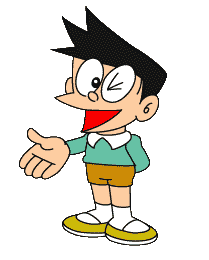
Suneo Honekawa (骨川スネオ) is a spoiled rich kid who likes to show off his cool stuff to his friends to make them jealous. The friends he hangs out mostly are Nobita, Shizuka, Doraemon, and Gian. He sometimes brags to his friends to things like meeting up with famous stars or to gain fame. He gets monthly pocket money of around 5000 yen and buys cool toys and comic books, but he never let nobita touches them to make nobita cry, angry and jealous. He usually hangs out with Gian to think he is the coolest kid in the world like Gian. He sometimes bully and/or beat up Nobita with Gian. Sometimes, he lies to Gian in order to please him and avoid being beaten up by him. He is a member of the baseball team named The Giants. He is not that good in baseball, but he is better than Nobita.

PersonalityEdit

Suneo1
New generation Suneo
ChordsOfFateAdded by ChordsOfFate

Suneo's personality is described as a cunning, prideful, cocky, arrogant, and narcissist, as he

Minggu, 10 Maret 2013

donal bebek

Donal Bebek

Dari Wikipedia bahasa Indonesia, ensiklopedia bebas
Langsung ke: navigasi, cari
Donal Bebek
Donald duck stor 121201c.jpg
Donal Bebek
Penampilan perdanaThe Wise Little Hen (Silly Symphonies) tahun 1934[1]
PenciptaWalt Disney
Pengisi suaraClarence Nash (1934-1985), Tony Anselmo (1985-sekarang)
Informasi terkait
Nama alias
SaudaraGober Bebek, Kwik, Kwek, dan Kwak, Hortensia Bebek, Dumbella Bebek, Kweker Bebek, Untung Angsa, Didi Bebek, Nenek Bebek, Agus Angsa
Binatang peliharaan
Rekan
MusuhPokijan, Gerombolan Siberat, Untung Angsa, Mimi Hitam
Donal Bebek adalah salah satu karakter Disney yang merupakan seekor bebek yang sering ditampilkan mengenakan baju pelaut biru / kelasi tanpa celana. Donal tampil pertama kali pada tanggal 9 Juni 1934 dalam kartun "The Wise Little Hen".
Menurut kartun Donald Gets Drafted (1942), nama lengkap Donal Bebek adalah Donal Fauntleroy Bebek (nama tengahnya merupakan referensi untuk topi pelautnya yang merupakan aksesoris untuk baju Fauntleroy). Situs Disney juga menyatakan bahwa namanya adalah Donal Fauntleroy Bebek dan sebuah episode dalam film Quack Pack juga menyatakan hal yang sama.[2]
Karakter Donal dengan suara khasnya merupakan hasil kerja dari pengisi suaranya, yaitu Clarence "Ducky" Nash. Karyanya inilah yang berhasil mengangkat Donal dan tertanam pada pemirsanya sebagai karakter dengan ciri khas yang unik.
Sifat Donal yang paling terkenal adalah sifatnya yang mudah marah. Dia juga sering dipecat dan berganti-ganti pekerjaan, namun itu menunjukan bahwa dia lebih terampil dari karakter Disney lain karena dapat bekerja hampir di segala bidang.
Hari ulang tahun Donal diakui jatuh pada tanggal 9 Juni 1934,[3] hari saat Donal muncul pertama kali, tapi dalam film The Three Caballeros, ulang tahunnya jatuh pada hari Jumat ke-13, bahkan, menurut kartun Donald's Happy Birthday, ulang tahun Donal jatuh pada tanggal 13 Maret.
Suara Donal yang terkenal disuarai oleh Nash, namun ia mengisi suara Donal hanya sampai tahun 1985, sejak tahun 1985, Donal disuarai oleh Tony Anselmo yang telah dilatih oleh Nash sendiri.[4]

micky mause

Mickey Mouse

From Wikipedia, the free encyclopedia
Jump to: navigation, search
Mickey Mouse
Mickey Mouse (present-day)
First appearanceSteamboat Willie (1928)[1]
Created byWalt Disney
Ub Iwerks
Voiced byWalt Disney (1928–1947)
Jimmy MacDonald (1947–1977)
Les Perkins (1986-1987)[2]
Wayne Allwine (1977–2009)[3]
Bret Iwan (2009–present)
Developed byFloyd Gottfredson
Fred Moore
Information
SpeciesMouse
GenderMale
FamilyMickey Mouse family
Significant other(s)Minnie Mouse
Pet dogPluto
Mickey Mouse is a funny animal cartoon character created in 1928 by Walt Disney and Ub Iwerks at the Walt Disney Studios.[4] Mickey is an anthropomorphic mouse who typically wears red shorts, large yellow shoes, and white gloves. As the official mascot of The Walt Disney Company, Mickey is one of the most recognizable cartoon characters in the world.
Mickey first was seen in a single test screening (Plane Crazy). Mickey officially debuted in November 1928 in Steamboat Willie, one of the first sound cartoons. He went on to appear in over 130 films including The Band Concert (1935), Brave Little Tailor (1938), and Fantasia (1940). Mickey appeared primarily in short films, but also occasionally in feature-length films. Nine of Mickey's cartoons were nominated for the Academy Award for Best Animated Short Film, one of which, Lend a Paw, won the award in 1942. In 1978, Mickey became the first cartoon character to have a star on the Hollywood Walk of Fame.
Beginning in 1930, Mickey has also been featured extensively as a comic strip character. His self-titled newspaper strip, drawn primarily by Floyd Gottfredson, ran for 45 years. Mickey has also appeared in comic books and in television series such as The Mickey Mouse Club (1955–1996) and others. He also appears in other media such as video games as well as merchandising, and is a meetable character at the Disney parks.
Mickey generally appears alongside his girlfriend Minnie Mouse, his pet dog Pluto, his friends Horace Horsecollar, Donald Duck, and Goofy, and his nemesis Pete, among others (see Mickey Mouse universe). Originally characterized as a mischievous antihero, Mickey's increasing popularity led to his being rebranded as an everyman, usually seen as an ever cheerful, yet shy role model. In 2009, Disney began to rebrand the character again by putting less emphasis on his pleasant, cheerful side and reintroducing the more mischievous and adventurous sides of his personality, beginnin

diego

Go, Diego, Go!

From Wikipedia, the free encyclopedia
Jump to: navigation, search
Go Diego Go!
GDGlogo.svg
FormatAnimated series
Created byChris Gifford
Valerie Walsh
StarringJake T. Austin (Seasons 1-3)
Brandon Zambrano (Season 4-5)
Matt Hunter (Seasons 4-5)
Gabriela Aisenberg
Keeler Sandhaus
Country of originUnited States
No. of episodes76
Production
Executive producer(s)Chris Gifford
Running time24 minutes
Broadcast
Original channelNickelodeon (2005–2009)
Nick Jr. (2009–2011)
Original runSeptember 6, 2005 – September 16, 2011
Chronology
Related showsDora the Explorer
Go, Diego, Go! is a children's television series created by Chris Gifferd and Valerie Walsh, and is a spin-off of Dora the Explorer. The show premiered on September 6, 2005 and ended on September 16, 2011 on Nickelodeon.[1] It also aired as part of the Nick Jr. on CBS block from September 17, 2005 to September 9, 2006. On December 20, 2006, Nick Jr. announced that it had ordered twenty new episodes that were in production.[2] Since April 2008, the show has been dubbed into Spanish and airs in the United States on Univision as part of their Planeta U block.

Contents

Setting

Diego and Baby Jaguar
The show features an 8 year old boy, Diego Márquez (voiced by Jake T. Austin Seasons 1-3; Brandon Zambrano Season 4-5; Matt Hunter Seasons 4-5), who rescues animals around the world. His cousin is Dora from Dora the Explorer, as revealed in multiple shows. Diego was first introduced in an episode of Dora the Explorer titled Meet Diego! (originally voiced by brothers Andres and Felipe Dieppa). Diego has a jaguar companion named Baby Jaguar who assists him in rescuing the animals. Thomas Sharkey, wh